About Us
We are the first to invent and patent a technological invention - an unmanned "Flying Aircraft Carrier" - a family of unmanned aerial vehicles (UAVs) and a counter-drone "system-of-systems" architecture - combined with the “THE-BEES,” a highly integrated air-maneuvering air-defense system concept for next-generation artificial intelligence (AI) autonomous UAVs and drone warfare.
The world is at the beginning of the most significant revolution in military affairs in human history
High-ranking defense experts and technology leaders from the US, NATO, the EU, and the G7 nations recognize that the world is at the beginning of the most significant and dangerous revolution in military affairs in human history, and that neither military nor political leaders have yet figured out what future warfare will look like.
This is mainly due to the rapid evolution of new technology, artificial intelligence (AI), robotics, and drone swarm warfare - including drones and UAVs carrying WMD (Chemical, biological, radiological, and nuclear) and the systems that deliver them.
Military and defense experts also recognized that since the post-Cold War era, the defense has not paid much attention to the use of cheap, less expensive UAVs and drone capabilities in warfare, even though many military studies have warned about the dangers of UAV and drone warfare. In 1997, the US Air Force Air Power Study explained the danger of UAVs and drone warfare, including UAVs and drones carrying WMD and delivering them.
If military and defense experts and governments do not pay close attention now, it will become an uncontrollably catastrophic event never seen or experienced before
The government, military, and defense experts also recognized that since the post-Cold War era, they have not paid much attention to the use of cheap, less expensive UAVs and drone capabilities in warfare, even though many military studies have warned about the dangers of UAV and drone warfare. In 1997, the US Air Force Air Power Study explained the danger of modern warfare. This issue should not be unattended. If enemies used WMD, it would be an uncontrollably catastrophic event, never experienced or seen before.
The 1997 US Air Force Air Power Study stated: “The potential exists for the proliferation of both UAVs and WMD to become widespread and thus a major security concern. There is no clear solution to this problem; however, actions including bringing the issue to the forefront, strengthening export and arms controls, deterrence, and defense will have a synergistic effect that will help mitigate this threat.” (Ref: The US Air Force Air Power Study (“Abstract” page v)
The United States, NATO, and the EU urgently seek close-range air defense systems
The United States, NATO, and the EU urgently seek close-range air defense systems that can integrate with existing systems and platforms to shield against close-range missiles, UAVs, and drone swarm threats. This urgency centers on identifying technological solutions to address major gaps in modern drone warfare, including 21st-century artificial intelligence (AI)-enabled autonomous electronic warfare and multi-systems capabilities that can contribute to modern deterrence and extended deterrence - to prevent conflicts and wars.
Who We Are
We are a Canadian company. For the past 17 years (since 2009), we have been researching, designing, inventing, and patenting a new and improved technological invention - a close-range, air-based air defense system concept, comprising the “mother hen and chicks scenario” of UAVs and drone-on-drone warfare platforms and systems, that can contribute to the United States and NATO's future military modernization of artificial intelligence (AI) and autonomous electronic warfare.
We particularly focus on counter-UAV and drone warfare strategies to address the issues and concerns of Cold War-era UAVs and drones carrying WMD (chemical, biological, radiological, and nuclear) and their delivery systems, which have not received much attention from G7 and NATO nations since the Cold War era, as well as modern deterrence and defense strategies to minimize, suppress, and defeat threats to avoid a WMD catastrophe in the future.
Civil preparedness for war “CBRNE Triangle Project" a modern total defense strategy
We also invented and developed a civil preparedness for war strategy, the “CBRNE Triangle Project,” a modern total defense strategy - if deterrence fails and WMD crises occur - to build an effective, interoperable workforce and work environment for military and emergency responders, including joint forces with healthcare workers. Most importantly, to build a distinctive identification and visual communication system platform - to manage CBRNE crises or deter and defend from such threats. We first introduced this system to law enforcement during the 2010 Vancouver Winter Olympics, and it was well received.
EQQUERA unmanned flying aircraft carrier Mothership scenario
EQQUERA's technological invention, Mother Hen and Parasitic Chicks (MHPC-ABADS), is a family of short-range, air-based air defense systems concept designed to enhance 6th-generation air dominance and information superiority. In particular, it aims to contribute to US and NATO's next-generation AI-driven drone-on-drone warfare and modern deterrence.
The EQQUERA unmanned airborne aircraft carrier concept is a moving airborne aircraft platform, similar to a military aircraft carrier at sea.
The concept was initiated in 2009, 17 years ago. This platform includes a mother unmanned aerial aircraft that carries a large number of small UAVs and drones (hundreds to thousands) with a system that launches and recovers them in mid-air.
MHPC-ABADS “technological invention” is a new and improved “Air-based air defense system” designed as a highly integrated air-based air defense shield - to intercept and defeat threats between space-based and ground-based systems - aiming to counter close-range missiles, UAVs, and drone swarm threats across all domains—air, sea, land, space, and cyberspace.
This “technological invention” is specifically designed to enhance U.S., NATO, and EU air defenses and to build modern deterrence and defense strategies for next-generation AI UAVs and drone warfare.
Recent UAVs and drone warfare have significantly reshaped military deterrence strategy by shifting traditional deterrence to modern deterrence
Modern AI UAVs and drone warfare require entirely new approaches to deterrence, since modern conflicts are fought across sub-conventional, space, cyber, and artificial intelligence domains. Traditional Cold War-era deterrence relied heavily on nuclear superiority and conventional forces. The Russia-Ukraine war and the Middle East's use of drones in ongoing conflicts are proving that traditional warfare deterrence is not sufficient to counter rapidly adapting threats.
21st-century warfare requires 21st-century deterrence : (Ref: Credit: The George C. Marshall Europe Center for Security Studies Security Insights - 21st Century Warfare Requires 21st Century Deterrence: by Colonel Jeffrey W. Pickler)
Deterrence strategies are mostly developed by governments with their militaries. However, designing and contributing to deterrence strategies by scientists, independent scholars, academics, and private researchers, including political and innovative thinkers, is not uncommon. Governments and militaries have widely accepted and recognized these contributions and citizen involvement since the 19th century and earlier.
In 2026, Russia and Ukraine are heavily involved in the “flying aircraft carrier” Mothership scenario - New Mothership Race
Recently, Russia has been using its medium-sized drones to fly smaller drones packed with explosives into combat, extending their range and creating deadly new problems for Ukrainian forces. Now, Ukraine claims it has taken a major step forward in developing an autonomous mothership drone scenario for future warfare. (Ref:-Credit: Illia Volynskyi Journalist for Defense - Mezha)
The Military Watch Magazine described:Russia Unveiling New ‘Drone Mothership Configuration' “Drones are expected to effectively become another type of airborne munition." Further stated, "The available descriptions indicate that the concept encompasses several possible roles. A small UAV could be released ahead of the fighter to conduct reconnaissance, search for air-defence systems or provide targeting information. Another variant could carry an electronic-warfare payload and attempt to interfere with enemy sensors and communications.” (Ref - Credit: Military Watch Magazine, Editorial Board Staff)
We focus on counter-UAV and drone warfare strategies to address concerns about Cold War-era UAVs and drones carrying WMD (chemical, biological, radiological, and nuclear) and their delivery systems. These issues have received limited attention from G7 and NATO nations since the Cold War era. We also focus on modern deterrence and defense strategies to minimize, suppress, and defeat threats - to help avoid a future WMD catastrophe
Our Mission - Finding solutions to the long-overdue issues of WMD-carrying UAVs, drones, and missile defense
(1) The President of the United States, Executive Order 12938 on November 14, 1994, declared a national emergency to address the danger of WMD and delivery systems, and their continued declaration
“—— the proliferation of nuclear, biological, and chemical weapons (“weapons of mass destruction”) and the means of delivering such weapons, constitutes an unusual and extraordinary threat to the national security, foreign policy, and economy of the United States, and hereby declare a national emergency to deal with that threat. — Presidential Executive Order 14 November 1994". (Ref: The US Air Force Air Power Study Chapter 3, page 13)
"—— Weapons of mass destruction—nuclear, biological, and chemical—along with the systems that deliver them, pose a major threat to our security and that of our allies and other friendly nations. Thus, a key part of our strategy is to seek to stem the proliferation of such weapons and to develop an effective capability to deal with these threats. President William J. Clinton - A National Security Strategy of Engagement and Enlargement." (Ref: and Credit: The US Air Force Air Power Study Chapter 1 Introduction - page 1).
The United States proposed the “Golden Dome” multi-layer missile defense system
In January 2025, United States President Donald J. Trump signed an executive order 14186 in January 2025 to establish the “Golden Dome” multi-layered missile defense shield to protect the United States from foreign threats. The system is intended to intercept everything from ballistic missiles to drones.
The Golden Dome features thousands of satellites and armed interceptors positioned in orbit to shoot down missiles during their initial launch phase or mid-flight.
The "Golden Dome" missile defense system driven by the US president's Executive Order in January 2025 - designed to shield North America from ballistic, hypersonic, and cruise missiles, and nuclear attacks – intended to detect and destroy them before they launch (boost phase) or during flight.
The “Golden Dome” is an advanced version of the Strategic Defense Initiative (SDI), also known as Star Wars, proposed in the early 1980s during the post-Cold War era by U.S. President Ronald Reagan on March 23, 1983. It aimed to create a space-based shield capable of intercepting and destroying incoming nuclear missiles.
On June 6 2026, US President signed the "Unleashing American Drone Dominance" executive order outlining how the United States would up its drone game in both the commercial and military sectors, including how it would deliver massive amounts of inexpensive, American-made, lethal drones to U.S. military units to amplify their combat capabilities.
European new drone wall concept and existing issues - January 2026
Meeting of the European Political Community, 2 October 2025 - French President Emmanuel Macron said that “Europe must scale up its air defense and deterrence capacities rather than rely on the idea of a “drone wall,” which he described as “not totally feasible.” (Ref and Credit: Anadolu Agency Turkish Inc.)
Recognizing the dangers of new UAVs and drone warfare, on January 22, 2026, the European Parliament adopted a resolution, officially treating unmanned systems as central components of modern warfare, known as the European Drone Defense Initiative, the European Drone Wall. (Ref: Eastern Flank Watch and European Drone Wall - European Parliamentary Research Service).
The European Drone Wall concept is a new system initiated by the European Union and NATO member states to build an integrated network of radars, electronic jammers, and interceptors to combat drone swarms.
The Drone Wall Concept involves low-altitude radars, AI-powered identification systems, and drone interceptors.
The European drone wall system is not designed for deterrence
Experts recognized that the system is not designed for deterrence. “True deterrence requires broader military strength, as discussed in this RAND commentary, rather than just focusing on the drone wall." In Europe, “the Problem Is Deterrence, Not Drones”. (Ref: Rand Corp.) "The Impossible Wall: Exposing Holes in European Strategy Against a Russian Drone Swarm. (Ref: NATO Association Canada)
It is evident that, most importantly, the EU “Drone Wall” initiative also requires a close-range air defense system that can be integrated into modern deterrence strategies to protect from WMD drone-on-drone and UAV warfare.
Global Superpowers - Arms Race for Swarming AI UAVs and Drones
The global superpowers, the US, Russia, and China, admit that 21st-century modern warfare significantly differs from traditional warfare. They also acknowledge that whoever develops a drone-on-drones swarm warfare strategy combined with artificial intelligence (AI) capabilities will play a significant role in the next generation of warfare and dominate the world.
The United States:
Aug. 28, 2025 - the US Defense Secretary Pete Hegseth calls for an Anti-Drone Task Force to stop a large-scale missile attack. Secretary Hegseth said via a video message released to the public. "Our job here at the Pentagon — when you think about it — is to prepare for the threats of the future and build a force to match them, and defeat them, and outpace them," - "And there's no doubt that the threats we face today from hostile drones grow by the day," he added. (Ref: The US Department of War - Matthew Olay-DoD news)
On August 28th, 2023, US Deputy Secretary of Defense Kathleen Hicks announced what she called "the Replicator initiative," an effort to modernize the American arsenal by adding fleets of Artificial-Intelligence unmanned, relatively cheap weapons and equipment.((Official Discusses Progress on Replicator - The US Department of War)).
Russia:
In September 2017, Russian President Vladimir Putin gave a televised address - a million Russian schoolchildren watched - "Artificial intelligence is the future, not only of Russia, but of all of mankind". Further said, "Whoever becomes the leader in this sphere will become the ruler of the world.” The Russian leader predicted that future wars will be fought by drones,, and "when one party's drones are destroyed by drones of another, it will have no other choice but to surrender." (Ref-Credit: Axios Media stated)
China:
Now, China is gearing up for a new kind of drone warfare, equipped with an Artificial Intelligence (AI) swarm-of-bees concept to overpower its adversaries. China is undergoing the most significant transformation of its nuclear forces in its history. China is developing a robust nuclear triad (land-, sea-, and air-based capabilities).
Given the new strategic environment, an electronic warfare strategy with new weapons-delivery capabilities has given the arms race a new face and deterrence a new dimension.
Exhibitions and Presentations
AUVSI 2013 - Washington, D.C., U.S.A.
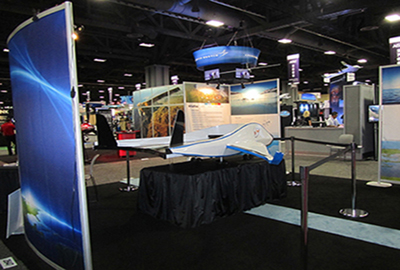
Mother Unmanned Aerial Vehicle - Scale Model
IEEA - Article Best concept Washington, D.C., U.S.A.
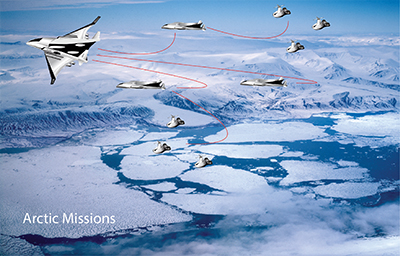
IEEE Spectrum, the flagship magazine and website of the Institute of Electrical and Electronics Engineers, recognized the EQQUERA Flatbed unmanned aerial vehicle as one of the most exciting concepts at the AUVSI 2013 event.
ASME 2013 32nd International Conference on Ocean, Offshore and Arctic Engineering
The American Society of Mechanical Engineers ASME - technical paper, "Knowledge of Arctic and EQQ Unmanned Aerial Vehicles for Multiple Applications."

Exhibitions and Presentations

Defence and Security 2014
Prague Czech Republic
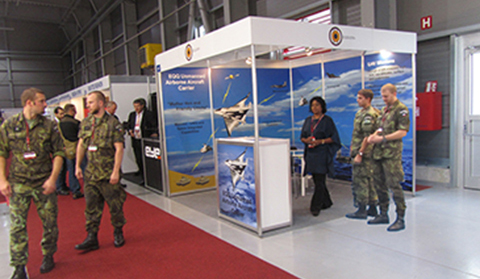
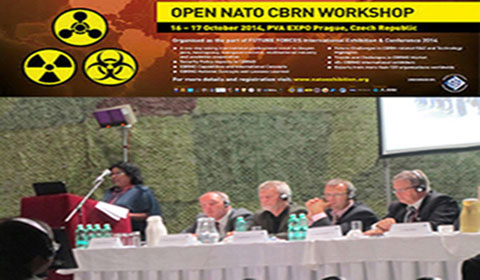
Exhibitor and Speaker: The FUTURE FORCES Exhibition and Conference 2014 is the largest-ever meeting of international military and political representatives from more than 80 countries, particularly those on the "21st-century soldier" projects, protection against weapons of mass destruction, and use of autonomous defense systems.

AUVSI 2014
Florida USA
Exhibitor: Exhibitor: AUVSI's Unmanned Systems 2014 is the largest trade show and conference dedicated to unmanned systems and robotics technologies, and it was held in Orlando, Florida, USA. For 40 years, AUVSI's Unmanned Systems has been organizing leading networking events for the air, ground, and sea unmanned systems industry.

OMAE 2013
Nantes, France
Speaker and Technical Paper Accepted: OMAE2013 is the 32nd International Conference on Ocean, Offshore, and Arctic Engineering conference (OMAE). The "ASME" The American Society of Mechanical Engineers accepted our technical paper "Knowledge of Arctic and EQQ Unmanned Aerial Vehicles for Multiple Applications."

AUVSI 2013
Washington D.C. USA
Exhibitor: AUVSI Unmanned Systems 2013 was held in Washington, DC, USA. Once again, they brought all the aerospace industry's players to showcase the latest innovations, technology, high-tech military equipment, and new aerospace technologies by leading industries. At the exhibition, we displayed the "Flatbed unmanned aerial vehicle" model.

Article - Best Concept
Advancing Technology for Humanity
We displayed the Flatbed unmanned aerial vehicle model at the conference. IEEE (the world's largest technical professional organization for advancing technology) recognized that the EQQ Flatbed unmanned aerial vehicle was one of the most exciting concepts at the AUVSI 2013 event.

ISPO 2013
Alaska USA
Speaker - Technical Paper Accepted:23rd Annual International Offshore and Polar Engineering Conference Alaska USA – 2013. The technical paper is related to integrating unmanned aircraft systems into Arctic operations. "Knowledge of Arctic and Unmanned Aerial Vehicles."

ArcticNet Conference 2012
Vancouver, BC Canada
Exhibitor: ArcticNet's latest Annual Scientific Meeting - ASM2012 - was held in Vancouver, British Columbia, Canada. Over many years, the Canadian Armed Forces have been expanding new defence activities from peacetime military engagements to defend Canadian sovereignty and security.

AUVSI 2012 USA
Las Vegas, USA
Exhibitor: AUVSI's Unmanned Systems North America 2012 was held from August 6 to 9, 2012 at Mandalay Bay in Las Vegas, USA. The conference focused on all domains, air, sea, and ground unmanned systems, maritime systems, and unmanned aircraft.

AUVSI Israel 2012
Tel Aviv, Israel
Technical Paper AcceptedInternational Conference on Unmanned Systems – AUVSI Israel 2012 held in Tel Aviv, from 20-22 March 2012. Israel pioneered the field of unmanned aerial vehicles for many decades, going back to the 1970s. Our Mother hen and parasite chicks unmanned aerial system technical paper was accepted.

AUVSI 2011
Washington, DC USA
Exhibitor: The AUVSI Unmanned Systems North America conference and exhibition took place in Washington, D.C., from August 16 through 19, 2011. The conference covered various military, civil, and commercial unmanned systems applications and unmanned vehicles for air, ground, and maritime use.

WILDLAND FIRE 2012
Seattle Washington, USA
Poster PresentationThe 3rd Human Dimensions of Wildland Fire Conference was held April 17-19, 2012, in Seattle, Washington, USA. We participated in a poster presentation on how UAVs can be used to combat wildfire situations. Military mobilization of military resources on wildfires goes back many decades.

Unmanned System Canada
2011 - Halifax, Nova Scotia Canada
Paper Accepted - SpeakerThe Unmanned System Canada conference was held in Halifax, Nova Scotia, Canada, on September 6, 2011. This conference included presentations from top defence officials and commercial sectors focusing on air, ground, and maritime unmanned systems for military, civil, and commercial applications.